
What a community-meeting draft can leave private
Draft a useful public update from a community meeting and give reviewers a separate decision about quotations and private context.
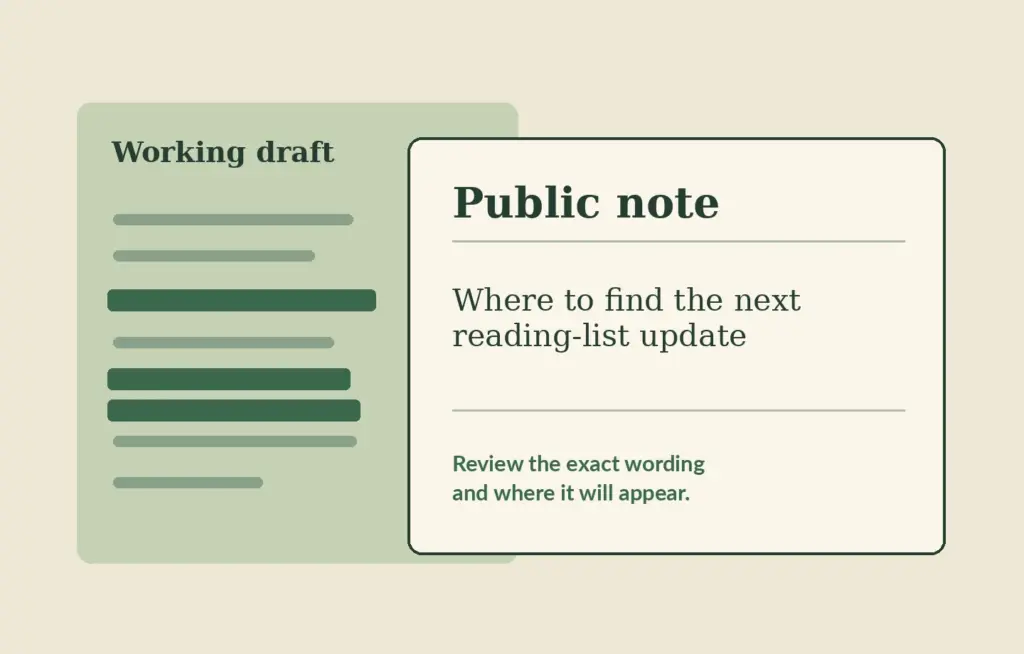
A public note can tell readers what a meeting decided without recounting everything people said to get there. Decide what the reader needs from the note before you write a draft. The decision could be as modest as where a revised resource list will appear and how to make a correction.
Choose what serves the public purpose
Imagine a fictional community meeting where organizers are revising a public reading list. People discuss a broken link, a recording that needs a fresh access check and an example raised as part of a private family experience. For readers, the useful news is that the organizers will verify the links and publish a revised list. The family experience may have helped the group understand the problem. It need not travel with the announcement.
This is also a test of what an apparently anonymous detail can reveal. In a small group, a date, role and description of an incident could identify the contributor even after the name is removed. If the public note can describe a decision without that detail, leave it out. Agree with the organizers about whether internal notes are needed, who can view them and how long they should be kept.
Ask for a decision on the actual public text
Give the designated reviewers a clean public draft. Say whether it will be posted on a website, emailed or both. Flag any quotation, image or identifying detail in that version. If a person’s words are proposed for quotation, invite them to review the words alongside the surrounding paragraph and proposed attribution. Where community protocols apply, ask the appropriate community contact how approval for those materials is handled. Review of the general update and approval of a specific contribution are distinct decisions.
The Oral History Association’s ethics statement describes giving narrators an opportunity to review interviews before public use. For a meeting note, the point to borrow is review of the actual material before release. Local Contexts provides resources for Indigenous communities to specify how knowledge and collections may be used, including community-defined protocols. Follow the relevant community’s direction for the material in front of you. Oral History Association ethics statement · Local Contexts.
In the example, the public draft can be two sentences: the reading list is being checked, and a revised version will appear on its existing page. If someone later proposes adding the private story, bring that proposal back for its own decision. Approval of the two sentences covers those two sentences.